AV customers increasingly expect meeting rooms and learning spaces to provide the same reliable experience across different locations, room sizes, and use cases. This creates an opportunity for integration teams to develop standardised designs that can be deployed repeatedly and supported efficiently.
In practice, however, a standard room is rarely entirely standard.
Different room conditions, customer requirements, network environments, and technology platforms can introduce complexity. Even when the system design is familiar, programmers may still need to move between configuration applications, set up devices individually, and complete additional routing before the room is ready.
Across one room, these steps may seem relatively small. Across tens or hundreds of rooms, they can have a significant impact on programming time, project consistency, and commissioning schedules.
Where Does Deployment Friction Come From?
AV systems typically bring together technologies from multiple manufacturers, each with its own capabilities and configuration requirements. This flexibility enables integrators to design the right solution for each customer, while also creating potential friction within the deployment workflow.
Common challenges include:
- Moving between design and configuration applications
- Working with different device integration methods
- Repeating configuration across similar rooms
- Managing audio routing, control, and network settings
- Maintaining consistent configuration and documentation
- Transferring system knowledge from commissioning to support teams
Together, these factors can affect how efficiently a system is programmed, commissioned, and supported.
Bringing TCC M Plus into the Q-SYS Workflow
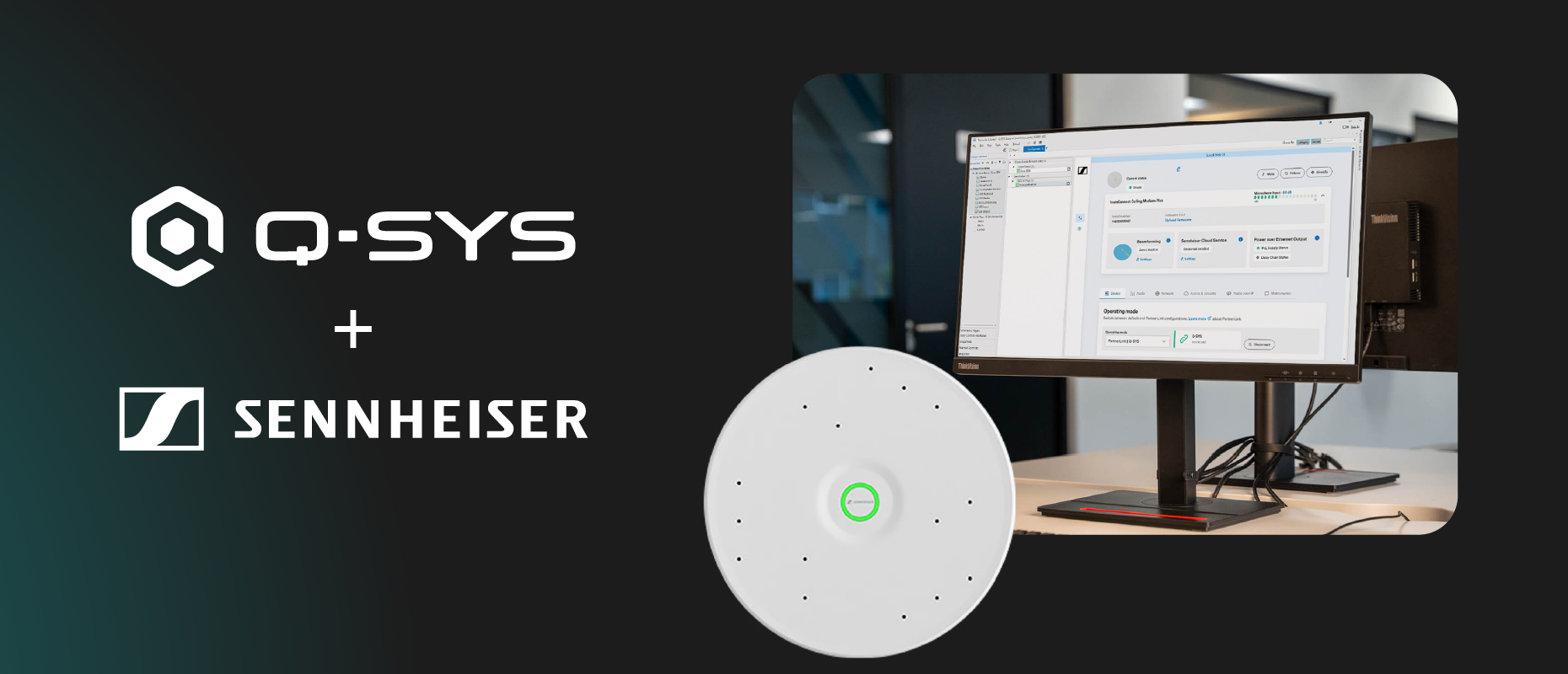
Co-developed by Q-SYS and Sennheiser, the Q-SYS Extension for Sennheiser PartnerLink enables TeamConnect Ceiling M Plus to appear as an inventory item in Q-SYS Designer Software. Programmers can identify, configure, and control the microphone directly within the Q-SYS workflow alongside other system components.
For supported TCC M Plus deployments using the extension, programmers can keep key microphone configurations within Q-SYS Designer, reducing the need to switch between configuration software. The extension also removes the requirement for a separate microphone plugin or third-party configuration software.
Other supported Sennheiser products continue to integrate effectively with Q-SYS through established plugins. These plugins are available in Q-SYS Library and remain an effective integration method for those products and applications, while the extension offers a more integrated Q-SYS Designer workflow for TCC M Plus.
Building More Repeatable Room Designs
Simplifying individual configuration steps is only part of the opportunity. The wider goal is to make successful room designs easier to repeat.
A repeatable design should provide a validated foundation while allowing the integrator to adapt it to the space and customer requirements. Keeping key TCC M Plus configuration within Q-SYS Designer gives programming teams a more consistent starting point when deploying similar systems across multiple rooms or locations. Plus, with Q-SYS Reflect, the room can be monitored and managed remotely, enabling quick decision making and delivering confidence in the system.
This can reduce variation between deployments, support more consistent documentation, and make it easier for another programmer or support engineer to understand the completed system. It also provides a more predictable workflow when a design needs to be adapted for different room sizes or customer requirements.
When programmers spend less time repeating routine configuration tasks or switching between software applications, they can focus on room performance, system optimization, and the customer-specific elements where their expertise creates the greatest value.
Supporting Integrations Over Time
Room standards do not stand still. Products, software, and customer requirements continue to evolve after the initial deployment.
Close engineering collaboration between Q-SYS and Sennheiser supports coordinated development and testing as the Q-SYS Platform and TeamConnect Ceiling M Plus evolve, helping integration teams deploy and support systems over time.
Standardisation will never mean that every room is identical. Q-SYS Designer Software provides a powerful, integrated environment for DSP and control programming. By bringing key TeamConnect Ceiling M Plus configuration into that same workflow, the Q-SYS Extension for Sennheiser PartnerLink reduces deployment friction and gives integrators a more consistent foundation for programming, commissioning, and supporting systems across multiple rooms.
See the Integration in Action
Join Sennheiser, Q-SYS, and AVI-SPL for an upcoming webinar on reducing deployment friction through more integrated AV workflows. Hear the integrator perspective on repeatable room design and see how TeamConnect Ceiling M Plus can be discovered, configured, and controlled within Q-SYS Designer Software.
Register for the webinar to learn more about the Q-SYS Extension for Sennheiser PartnerLink and how TeamConnect Ceiling M Plus integrates with Q-SYS Designer Software.
Explore the Q-SYS and Sennheiser partnership, solutions, and resources at Q-SYS and Sennheiser.