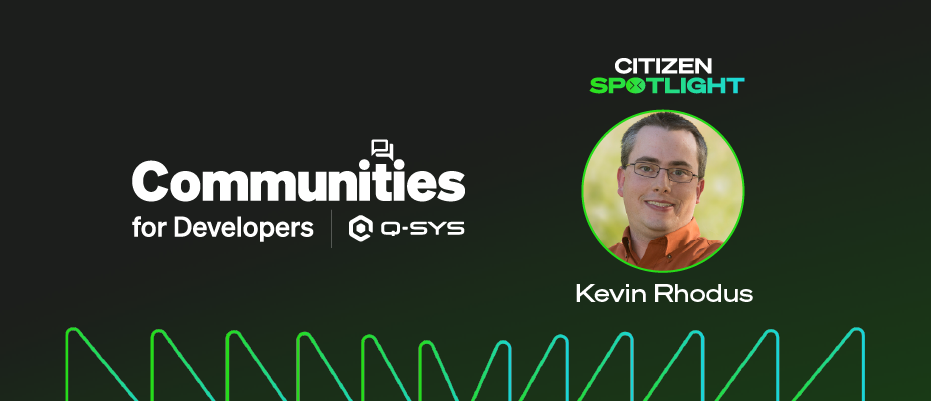

Kevin Rhodus, Platform Integration Manager at Q-SYS, has built a career on solving complex problems, from integrating third-party platforms to designing scalable systems that redefine the AV experience. This feature dives into Kevin’s story and some of his best projects, including a magical holiday light show spanning 12-acres and 400,000+ channels of lights, all controlled and monitored by Q-SYS.
Kevin’s Background and Leap to Q-SYS
“I started working in AV in high school,” Kevin recalls. “My first job was at the City of Dublin’s Abbey Theater. At the same time, I volunteered at the Columbus Zoo and attended their Zoo School program.” During a research study, Kevin connected with the zoo’s Media Productions department, which handled everything from photo/video production to maintaining parkwide audio systems. He joined and over time, the team evolved into a full theatrical production and AV installation department.
Kevin continued working in AV throughout college, gaining experience in system design, installation, and programming. “I built an in-house AV portal using Active Directory Organizational Units to grant access to AV systems based on a user’s Windows login back in 2010,” he reflects. In school, he took every video and audio production class he could find, and eventually even created his own major—Audio/Visual Design for Natural Resources.
After college, Kevin joined SoundCom Systems, a regional integrator in Ohio. “I started as an engineer, handling pre-sales and post-sales design, CAD, and programming projects,” Kevin explains. “That gave me a diverse background in control and DSP systems. When the Core 110f launched, we quickly transitioned many projects to Q-SYS control. By the end of my six years at SoundCom, I was a full-time programmer handling most of our Q-SYS programming.” At Q-SYS, he’s worn many hats, from Advanced Applications Engineer to now Platform Integration Manager, providing high-level technical support to large, multinational partners and designing, developing, and programming Q-SYS Experience Centers across the US.
Kevin’s approach to integrating third-party platforms with Q-SYS is rooted in adaptability. “One of the most powerful aspects of Q-SYS is how easily it leverages third-party integrations to expand the platform’s capabilities,” he shares. “I always ask how I can expand my toolbox to solve problems.” With tools like APIs and Q-SYS Open, Kevin combines native strengths with external capabilities to address real world problems. For example, during the early days of COVID, Kevin devised a solution that created QR codes via API calls, allowing users to control meeting rooms using their own devices.
Projects That Change the Game
When we asked about his most impactful projects, Kevin recalls working on the audio distribution system at Churchill Downs, home of the Kentucky Derby. “In 2019, they had over 30 different DSPs, each running its own area, with common feeds sent over Cobranet, QLAN, Dante, and analog lines. Adjusting audio in any area required figuring out which system covered the area and which of a dozen gain knobs to adjust,” Kevin explains. “This process typically took multiple team members over an hour, and once adjusted, there was no easy way to reset the system to a nominal level.”
Kevin’s team consolidated everything into a single Q-SYS design that runs the entire facility, enabling staff to manage audio from one intuitive interface. The system also integrated a variety of 3rd party devices to extend capabilities and introduce proactive monitoring for equipment racks located outdoors or in remote shared spaces. Previously, the only way the team knew there was an issue in one of these locations was to react to reports of outages.
Finally, Q-SYS allows the system to scale as the facility grows, future-proofing the solution for years to come. “Each of the 30+ schematic pages are laid out in a standardized way that allows users to easily identify what is happening across the entire facility,” Kevin explains. “Since completing the project, they have added multiple new venues to their system while maintaining a consistent and easy-to-follow signal flow and user interface.”
Q-Control and the Importance of Scalability
When asked about a plugin he’d like to spotlight, Kevin told us about Q-Control, a show controller he developed to support the various use cases and device integrations required for Q-SYS Experience Centers. It started with tailored cues and controls for specific devices in the Austin Experience Center, but today, it’s a scalable, JSON-driven solution that is reusable and collaborative. Kevin shares that “Q-Control now supports multiple shows, non-linear scenes, control via Q-Control style notifications, and incoming control over UDP messages from third-party devices to trigger cues or scenes.” These changes elevated Q-Control into a scalable tool that can be used in projects in the Costa Mesa Experience Center and at nationwide tradeshows, a perfect example of the importance of designing systems to scale.
“I always approach projects with scalability and reusability in mind. As we teach in training—if you’re going to do something more than once, write a function. I apply the same philosophy to system programming,” Kevin says, and shares the following best practices he’s learned over the years.
- Build each script or plugin to accomplish a single task. A script should communicate with one device or perform one type of action. This makes troubleshooting easier and prevents one code issue from impacting the entire control system.
- Design scripts so they can be used like any other block in Q-SYS Designer. IP addresses, usernames, passwords, and settings shouldn’t be hidden variables in the code; they should be controls presented to the user. Kevin’s tip: use UI panels in Text and Block Controllers to create user-friendly interfaces that feel like native Q-SYS components.
- Build scripts to scale easily for future applications. Use arrays of controls instead of multiple individual controls to allow scripts to scale up or down without reprogramming. Further, by leveraging scripting concepts like ipairs loops, scripts can be resized by any user without having to adjust the code.
Sparking Holiday Cheer with a Q-SYS Controlled Light Show 🎄
Speaking of scaling systems, let’s dive into one of Kevin’s projects that brings new levels of cheer every holiday season. In his neighborhood, Kevin runs a 12-acre holiday light show and uses the Q-SYS Platform to ensure the 400,000+ channels of lights shine bright every night.
Kevin originally connected Q-SYS to his holiday lights to solve a basic problem—a controller that would drop offline about once a week. “Each night, I would look out the window and see part of the woods dark,” Kevin reflects. “I wanted to find a way to notify us when the controller went offline so we could respond more quickly. Fast forward a few years, a few thousand lines of code, and one massive Q-SYS file, and now the system not only alerts us but also automatically reboots any faulted controller and self-heals.”
Each year, Kevin’s community is raising the bar on what this show can achieve. Kevin’s Q-SYS-powered system now runs redundant show players and FM transmitters, integrates MQTT for efficiency, and monitors every pixel with Q-SYS Reflect for real-time alerts and remote control of the show, which allowed it to run 100% of the scheduled time last year. When individual sections had issues, Q-SYS instantly resolved them.
“It’s been amazing to see what started as two neighbors putting up lights in the woods become a family tradition for so many in our local community,” Kevin reflects on how the project began years ago. “My neighbor and I talked in depth about wanting to turn the woods into a light show. I got married in October and designed a light show for our Halloween-themed wedding, which introduced me to Vixen/xLights and Falcon Pi Player. Shortly after, my neighbor and I decided to jump in and pull off a light show in a month. That first year, we had three houses and 160 channels of control of standard strands of lights. Fast forward nine years, and we’re now up to nine houses and 420,000 channels of control (140,000 individual pixels), and we keep growing each year.”
With the community asking what the show was for and where to donate, Kevin and his neighbor quickly realized they could use the light show to raise money for a good cause. They formed a non-profit organization that raises donations for a local charity chosen by the neighborhood each year. Over the history of the show, they’ve raised more than $100,000 and donate 100% of the money to the selected non-profits!
Watch the Magic in Action
Want to see more on Kevin’s holiday light show? Join the live Deep Dive webinar next Tuesday. Click here to register.
If you’re more of a podcast person, Kevin covered this topic as a recent guest on Ask the Programmer with James King and Steve Greenblatt. Click here to listen.

Jason Martinez
Neueste Artikel von Jason Martinez (alle ansehen)
- Citizen Spotlight: Kevin Rhodus’ Holiday Light Show - December 17, 2025
- Citizen Spotlight: Behind the Screens - September 25, 2025
- Developer Spotlight: Drivers of Innovation – The Chowmain Way - August 26, 2025